
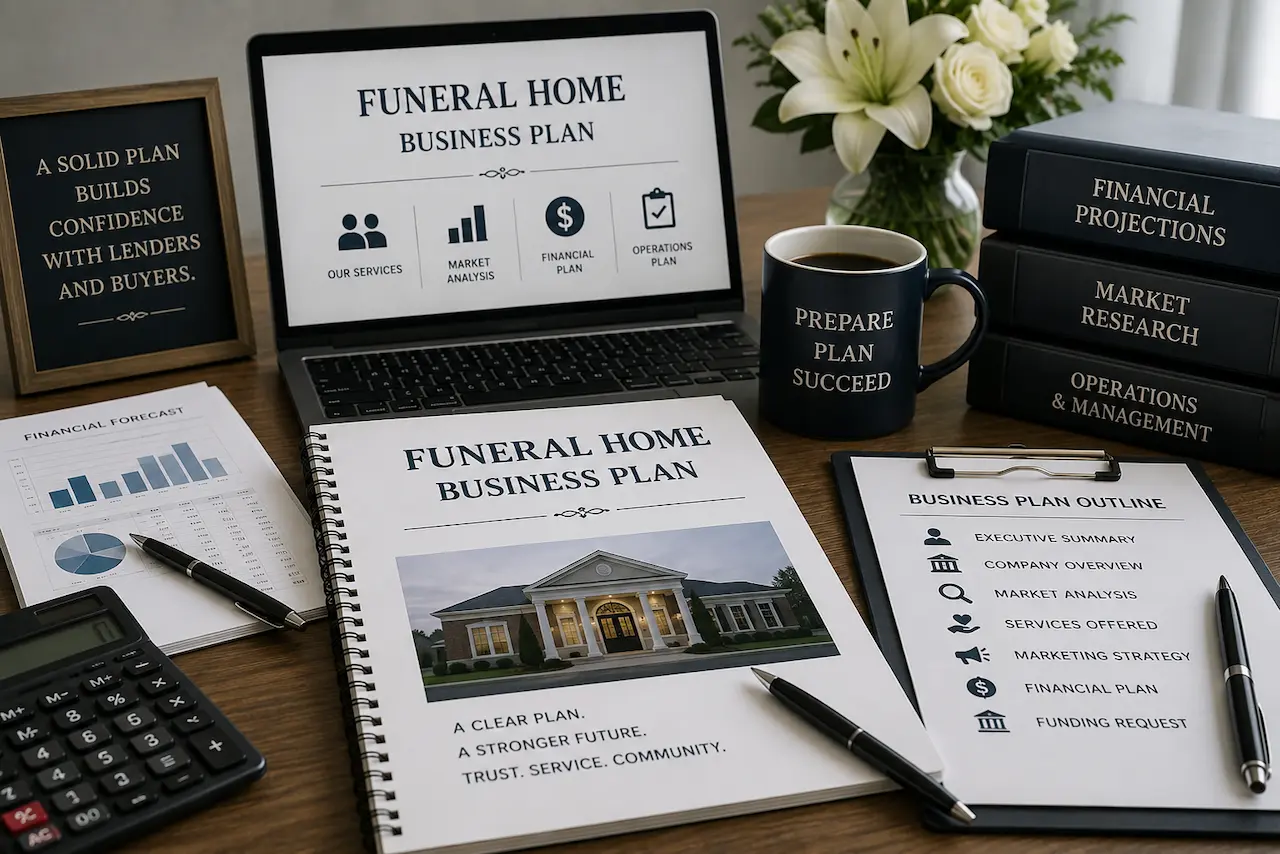
How to Prepare a Business Plan for a Funeral Home — What Lenders and Buyers Actually Need
A funeral home business plan means different things depending on who is asking for it.
A buyer seeking SBA financing needs a document that satisfies a lender’s underwriting requirements. A seller preparing for due diligence needs documentation that explains the business clearly to a buyer who has never operated in the funeral industry. Both need to understand what goes in, what gets left out, and why the standard business plan template fails for funeral home transactions specifically.
I have reviewed hundreds of funeral home financials over the past twenty years. The owners who move through transactions quickly and cleanly are almost always the ones who understood early that a funeral home business plan is not a marketing document. It is an evidence package one that answers the questions a lender or buyer will ask before you have to.
This is what that package looks like.
Why the Standard Business Plan Template Does Not Work
Pick up any small business planning guide and you will find a familiar structure: executive summary, market analysis, competitive landscape, management team, financial projections, funding request.
That structure was built for startups. For businesses seeking venture capital. For founders trying to convince investors that an idea has commercial potential.
A funeral home transaction is none of those things.
The business already exists. The revenue history is documented. The market is defined by geography and demographics, not by customer acquisition strategy. The management team is the owner. And the most important financial document is not a projection it is three years of actual tax returns and profit and loss statements that a lender will scrutinize line by line.
When a funeral home owner shows up to an SBA lender with a polished business plan that projects growth without explaining the historical financials clearly, the lender does not find it reassuring. They find it suspicious. Projections without history are noise. History, documented and explained, is what drives an approval.
The funeral home business plan that actually works looks very different from what most people expect.
What an SBA Lender Needs — And Why
SBA 7(a) loans are the most common financing structure for funeral home acquisitions. The lender’s job is to determine whether the business generates enough cash flow to service the debt at the proposed purchase price. Everything in the business plan either supports or undermines that determination.
Here is what an SBA lender is actually evaluating:
Seller’s Discretionary Earnings — verified, not claimed
The lender will calculate SDE themselves from the tax returns and financials. If the owner’s stated SDE does not match what the lender calculates, the underwriting process becomes adversarial. Every add-back every personal expense run through the business, every one-time item that inflated costs in a given year needs to be documented and defensible before the lender asks about it.
Call volume — three years, documented
Call volume is the fundamental driver of a funeral home’s economic value. A business doing 150 calls per year is a different business than one doing 300 calls, even if the revenue looks similar on paper due to pricing differences. Lenders want to see call volume trend data not just the current year to understand whether the business is stable, growing, or declining.
Preneed contract balances and obligations
Preneed represents both an asset and a liability in a funeral home transaction. A lender needs to understand the total preneed balance, how it is held, what the cancellation provisions are, and what the obligation looks like for the new owner at closing. This is not something most business plan templates ask about. It is something every funeral home lender asks about.
Real estate — owned or leased, and what it means for the deal
Whether the funeral home owns or leases its facility fundamentally changes the transaction structure. Owned real estate typically adds value but also affects how the SBA loan is structured between the real estate and business components. A lender needs to see an accurate real estate picture ownership documentation, current lease terms if applicable, and a realistic appraisal basis before underwriting begins.
Debt service coverage — at the proposed purchase price
This is the number that determines whether the deal closes. The business must generate enough cash flow, after the owner’s reasonable compensation, to service the acquisition debt at the proposed price. If it does not, no amount of well-written narrative will change that. This calculation needs to be done honestly and ideally by someone who has done it for funeral home transactions specifically before an asking price is set.
A complete documentation package also helps clarify what your funeral home is actually worth, because valuation depends on verified earnings, call volume, real estate, goodwill, and buyer risk.
What a Buyer Needs From the Seller’s Documentation
A buyer who is considering acquiring your funeral home is trying to answer one question above all others: is what I am being told about this business accurate?
The documentation you provide what I would call the seller’s business package rather than a traditional business plan needs to answer that question proactively. Not reactively. If a buyer has to ask for something that should have been in the initial package, it signals disorder. Disorder creates doubt. Doubt delays deals or kills them.
Here is what belongs in a seller’s business package:
Three years of federal tax returns — business and personal
The business returns establish the financial history. The personal returns allow the buyer to understand owner compensation and benefits that run through the business. Both are required by SBA lenders and serious buyers will expect them from the first substantive conversation.
Profit and loss statements — current and trailing
Tax returns tell you what happened at year end. Profit and loss statements tell you what is happening now. A buyer will want to see P&Ls that are current within sixty days, alongside the annual history. If there is a significant difference between the year-end financials and the current YTD performance, that difference needs an explanation before the buyer asks for one.
Annual call totals — by year, by service type
Three years of call volume, broken down by burial and cremation, tells a buyer the story the revenue numbers do not fully tell. A business where cremation volume is growing at the expense of higher-revenue burial services has a different trajectory than one where total call volume is growing across both service types. The call volume history is often the single most revealing document in a funeral home transaction.
Balance sheet — current and dated
The balance sheet shows what the business owns, what it owes, and what the net equity position looks like. For funeral home buyers, the balance sheet is particularly important for understanding equipment age, vehicle fleet, preneed trust balances, and any outstanding debt that affects the deal structure.
Real estate documentation
If the funeral home owns its facility, a current deed and most recent property tax assessment establishes a baseline. If it leases, the full lease including any renewal options, rent escalation clauses, and landlord transfer requirements belongs in the package. A buyer who discovers a problematic lease after making an offer has every reason to reprice or walk away.
Pre-need contract summary
Total preneed balance, trust management structure, state regulatory requirements for transfer, and a summary of the major preneed relationships. A buyer taking on preneed obligations needs to understand what they are taking on before they commit.
Sellers should pay close attention to preparing pre-need contracts and client data for due diligence, because these records can affect buyer confidence, lender review, and closing conditions.
Business history and market context
Not a marketing pitch. A factual explanation of how the business was built, who the key relationships are, what the service culture is, and what makes this business work in this specific market. A buyer who understands the story is a buyer who can evaluate the fit and a buyer who understands fit is a buyer who closes.
From the buyer’s perspective, this package becomes the foundation for due diligence when purchasing a funeral home business, especially when reviewing financial history, call volume, preneed obligations, and transfer risk.
The Document That Causes the Most Problems
In my experience, the single document that causes the most friction in funeral home transactions is the add-back schedule.
An add-back is an expense that was charged to the business but was not actually a cost of running the business personal vehicle expenses, personal insurance, owner family compensation, one-time legal or equipment costs, and similar items. These reduce taxable income on paper but represent real economic benefit to the owner that a buyer would not incur.
Documenting add-backs clearly with a line-by-line explanation and supporting documentation is essential for establishing accurate SDE. Without it, a lender or buyer who reviews the tax returns sees a business with lower earnings than it actually produces. The asking price looks high relative to what the financials show. And the natural response is to push back on price rather than accept an explanation that has not been provided.
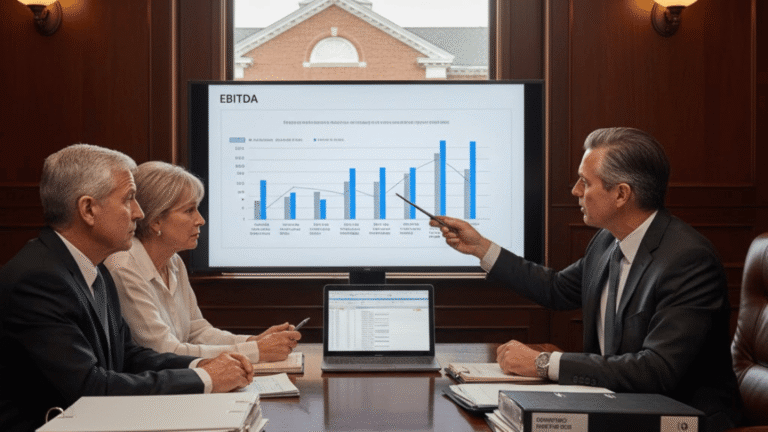
Because add-backs directly affect earnings, sellers should understand SDE and EBITDA in funeral home valuation before presenting financials to buyers or SBA lenders.
I have watched transactions stall for weeks over add-backs that were perfectly legitimate but were never documented before the buyer asked about them. The documentation is straightforward. The friction it creates when it is missing is not.
Preparing the add-back schedule before any buyer conversation with the same care you would put into the financial statements themselves is one of the most effective things a seller can do to protect their asking price.
What Financial Projections Are Actually Worth in This Context
Here is the honest answer: not much.
Lenders and buyers in funeral home transactions are evaluating what the business has done, not what the owner believes it will do. A three-year history of consistent call volume, stable margins, and clean financials is worth more than any forward projection.
This does not mean projections are useless. They have a role in specific situations if the business has made a significant operational change that has not yet shown up in the historical financials, or if a new facility is being built that will affect capacity, a well-supported projection can provide useful context.
But the projection needs to be grounded in something verifiable a signed lease, a construction contract, call volume data that supports the growth assumption. A projection that simply assumes revenue increases at a rate the history does not support is a document that creates skepticism, not confidence.
If you want to communicate growth potential to a buyer, the most effective way to do it is through the historical story showing the trajectory of the last three years rather than projecting a trajectory that has not happened yet.
The Funeral Home Business Plan That Actually Closes Deals
After twenty years of working with funeral home buyers and sellers, the documentation packages that produce smooth transactions share a common characteristic: they answer questions before they are asked.
Not because the sellers were trying to be impressive. Because they understood that a buyer or lender who has to ask for something basic is a buyer or lender who is already wondering what else they do not know.
The package that works is not complicated. It is complete. It is organized. And it is honest including the parts that are not perfect, explained in a way that removes doubt rather than inviting it.
Three years of tax returns and financial statements. Current P&L. Call volume history by year and service type. Balance sheet. Real estate documentation. Preneed contract summary. Add-back schedule. Business history and market context.
That is the funeral home business plan that matters. Not the one built from a template. The one built from the actual story of the business you have spent your career creating.
If you are preparing to sell and want to understand whether your documentation is ready for buyer and lender scrutiny, a confidential conversation about your situation is the right first step. There is no obligation and no exposure just an honest assessment of where you stand and what, if anything, needs to be addressed before you begin.
Frequently Asked Questions
Do I need a formal business plan to sell my funeral home?
Not in the traditional sense. What you need is a well-organized documentation package three years of tax returns and financials, call volume history, balance sheet, real estate documentation, preneed summary, and an add-back schedule. That package does the job a business plan is supposed to do, but it is built from verified history rather than projections.
What do SBA lenders actually look for in a funeral home business plan?
SBA lenders are primarily evaluating debt service coverage whether the business generates enough cash flow to service the acquisition loan at the proposed purchase price. The documents that drive that evaluation are the tax returns, profit and loss statements, and call volume history. Narrative business plans are reviewed but they do not substitute for clean, documented financials.
How important is call volume in a funeral home business plan?
It is one of the most important elements. Call volume broken down by year and by service type tells the story the revenue numbers alone do not tell. Lenders and buyers use call volume trend data to assess business stability, market position, and the trajectory of the business. Three years of well-documented call volume is essential.
What are add-backs and why do they matter?
Add-backs are expenses charged to the business that were not actual costs of running the business personal vehicle expenses, personal insurance, family compensation, and similar items. They reduce taxable income on paper but represent real economic benefit to the owner. A documented add-back schedule is essential for establishing accurate Seller’s Discretionary Earnings and protecting the asking price.
Should I include financial projections in my funeral home business documentation?
Only if they are grounded in something verifiable. Projections that are not supported by historical data or specific documented changes to the business tend to create skepticism rather than confidence. The historical story three years of clean, consistent performance is more persuasive than any projection.
How early should I start preparing my business documentation before a sale?
At least twelve to eighteen months before you intend to sell. That window allows time to organize financials, document add-backs, address any gaps in the call volume record, and assess whether there are operational or compliance issues that could create friction during due diligence. Sellers who prepare early have more options and better outcomes than sellers who prepare under pressure.
What happens if my financials have inconsistencies or gaps?
Address them with documentation and explanation before a buyer asks about them. Every gap that a buyer has to ask about is a moment of doubt in the transaction. Most inconsistencies have legitimate explanations a one-time expense, a staffing change, a year where the business was transitioning. Documented and explained proactively, they become part of the story. Discovered unexpectedly during due diligence, they become a reason to renegotiate or walk away.
Helpful next steps for this topic




Please Share this Article if you think others would find it Informative:
