
How Much Cash Do You Need to Buy a Funeral Home?
Buying a funeral home requires more than securing financing for the purchase price. Even when a lender funds most of the acquisition, buyers must account for down payments, closing expenses, working capital, and additional cash reserves.
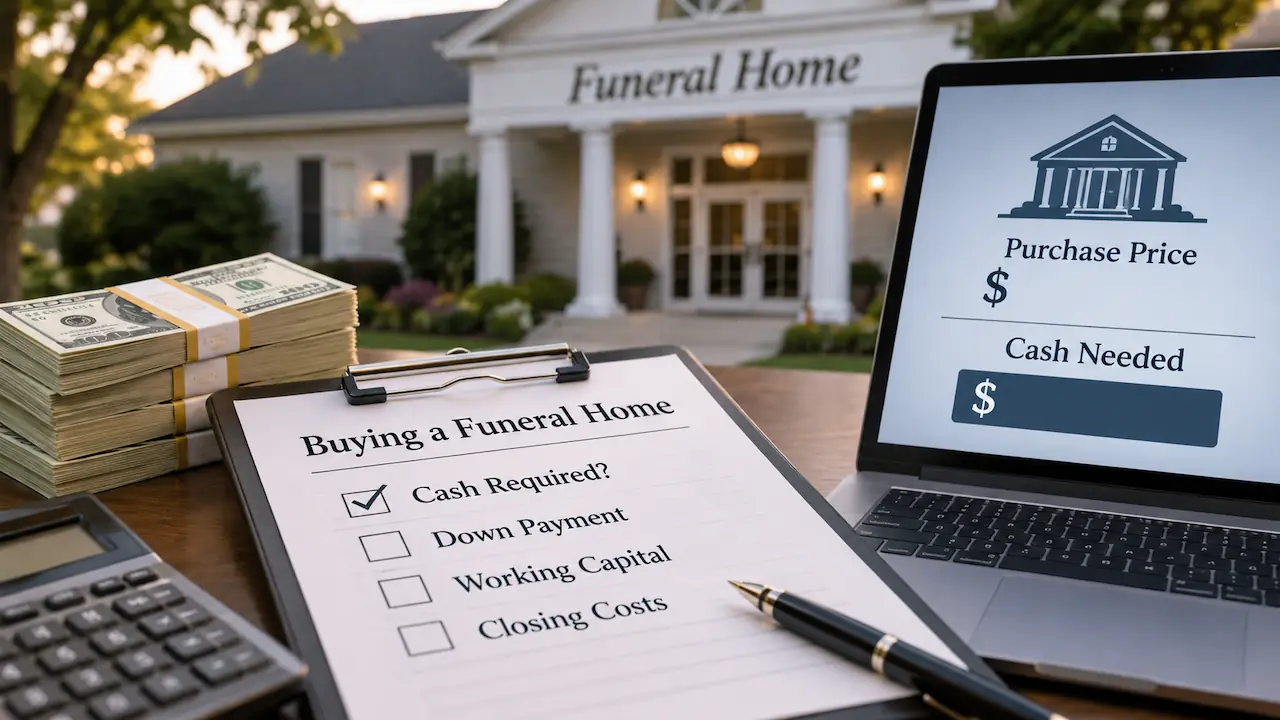
For first-time buyers, these requirements can be difficult to estimate before speaking with a lender.
A funeral home priced at $1.5 million does not necessarily require $1.5 million in available cash. However, the money needed to complete the transaction may be considerably higher than the down payment alone.
Before making an offer, I recommend preparing a complete acquisition budget that identifies both financing requirements and the cash needed to operate after closing.
How Much Down Payment Do You Need to Buy a Funeral Home?
The required down payment depends on the financing program, buyer qualifications, and transaction structure.
For eligible SBA 7(a) business acquisitions involving a complete change of ownership, the standard minimum equity injection is generally 10% of total project costs.
Importantly, total project costs may include more than the purchase price.
Eligible acquisition expenses, initial working capital, and certain closing costs may also be included when determining the overall financing requirement.
A conventional lender may require a different contribution based on the borrower’s financial position and the business’s risk profile.
For example, a buyer purchasing a $1.5 million funeral home could need more than $150,000 in equity if the total project cost includes additional expenses.
My funeral home financing resources provide further information about acquisition loans and financing considerations.
What Cash Expenses Should Funeral Home Buyers Expect?
A realistic acquisition budget should separate the buyer’s required equity from other expenses that may arise during the transaction.
Buyer Equity Contribution
The equity contribution represents the buyer’s required investment in the acquisition.
Lenders typically verify the source and availability of these funds before closing.
Depending on the applicable program rules, approved funding sources may include eligible personal funds, investments, or qualifying outside contributions.
Due Diligence and Closing Expenses
Before purchasing a funeral home, buyers may need professional assistance with:
- Legal review and purchase agreements
- Financial due diligence and accounting
- Business valuations and real estate appraisals
- Property inspections
- Licensing and transaction documentation
Some expenses may qualify for financing. Others may require separate cash payments, sometimes before the loan closes.
Initial Working Capital
Working capital supports daily operations immediately after ownership transfers.
A buyer may need money for payroll, utilities, insurance, supplies, vehicles, and other ongoing obligations.
The necessary amount depends on operating expenses, payment collection patterns, and existing business liquidity.
Additional Cash Reserves
Cash reserves provide a financial cushion for unexpected expenses after closing.
These funds should be considered separately from the working capital already included in the acquisition budget.
Keeping additional liquidity can help a new owner manage repairs, temporary revenue fluctuations, and other unforeseen obligations.
Example: Cash Needed for a $1.5 Million Funeral Home Acquisition
Consider a hypothetical funeral home acquisition financed through an eligible SBA 7(a) loan.
The following example illustrates how purchase expenses and cash requirements fit together.
| Financial Measure | Amount |
| Purchase price | $1,500,000 |
| Closing and transaction costs | $40,000 |
| Initial working capital | $110,000 |
| Total project cost | $1,650,000 |
| Illustrative 10% equity | $165,000 |
| Additional reserves | $35,000 |
| Cash planning target | $200,000 |
The buyer’s illustrative equity contribution is $165,000, calculated as 10% of the $1,650,000 total project cost.
If the remaining $1,485,000 is approved for financing and the buyer retains another $35,000 in reserves, the planning target becomes $200,000.
This calculation assumes all included project expenses are eligible and the lender approves the proposed structure.
The $200,000 figure is an illustrative planning target, not a guaranteed minimum. Actual funding requirements depend on the borrower, lender, and transaction.
Some buyers may need additional cash for expenses that cannot be financed or must be paid before closing.
What Are the SBA Equity Requirements in 2026?
SBA financing rules are important because they determine which contributions may satisfy the required equity injection.
Under SBA SOP 50 10 8.1, effective October 1, 2026, eligible complete business acquisitions generally require a minimum 10% equity contribution.
However, not every funding source receives identical treatment.
Can Seller Financing Count Toward the Down Payment?
Seller financing may help structure an acquisition, but it does not automatically satisfy the buyer’s equity requirement.
Under SOP 50 10 8.1, seller debt generally must be subordinated and placed on full standby for the life of the SBA loan to qualify toward the equity injection.
For ordinary acquisitions, qualifying seller debt, other standby debt, and certain non-controlling minority equity investments are subject to limits on the portion of the required equity they can collectively provide.
A seller note that does not satisfy these requirements may still be considered in the overall financing structure, subject to lender approval.
New SBA Flexibility for Eligible Veteran Buyers
A policy effective November 11, 2026, provides additional flexibility for eligible veteran buyers acquiring existing businesses through the SBA 7(a) program.
Under this policy, qualifying veterans may satisfy their full required equity contribution using permitted outside sources, including eligible standby debt, seller debt on full standby, and qualifying non-controlling minority equity investments.
This flexibility does not remove the equity requirement or guarantee financing approval.
Eligibility, funding documentation, and lender requirements still apply.
Because these provisions can materially affect the cash needed for an acquisition, I recommend confirming the applicable rules before negotiating seller financing.
How Much Working Capital Should You Have After Closing?
Working capital depends on the funeral home’s monthly operating expenses and collection patterns.
For example, if essential monthly expenses total $45,000, two months of operating coverage would represent $90,000.
This is only an illustration, not a standard lender requirement.
Buyers should evaluate existing cash, accounts receivable, prepaid funeral obligations, and expected operating expenses before determining an appropriate amount.
A thorough review of the acquisition’s financial position is an important part of evaluating a funeral home purchase.
What Do Lenders Review Besides Available Cash?
Having the required down payment does not guarantee approval.
Lenders also examine the funeral home’s ability to generate enough sustainable income to support debt payments.
Important considerations include historical earnings, annual call volume, existing liabilities, buyer experience, credit history, and the proposed acquisition structure.
Even a buyer with substantial savings may struggle to finance an overpriced funeral home.
Understanding what makes a qualified funeral home buyer helps clarify the financial and operational requirements involved.
How to Prepare Your Acquisition Cash Budget
Before submitting an offer, prepare a budget covering the purchase price, transaction expenses, working capital, required equity, and additional reserves.
Confirm which costs can be financed and which must be paid directly.
Then compare your available funds with lender requirements and the funeral home’s expected operating cash flow.
The goal is not simply to secure enough money for closing. It is to purchase a business that can support its financing and operate sustainably afterward.
Frequently Asked Questions
Can I buy a funeral home with 10% down?
Some eligible SBA 7(a) acquisitions may qualify with a 10% equity contribution based on total project costs. Actual requirements depend on the transaction, buyer qualifications, applicable rules, and lender approval.
Are funeral home closing costs included in an acquisition loan?
Certain eligible closing and transaction expenses may be financed. Other costs may need to be paid separately or before closing, depending on the lender and financing program.
How much working capital should I have after buying a funeral home?
The appropriate amount depends on monthly operating costs, available liquidity, and expected collections. Review the business’s financial performance and establish a reserve suited to its circumstances.
Can seller financing replace my down payment?
Not automatically. Qualifying seller debt generally must meet SBA standby and other requirements. Eligible veteran buyers may have additional equity-source flexibility under the policy effective November 11, 2026.
Do lenders require cash reserves after closing?
Lenders may evaluate post-closing liquidity and require reserves based on the transaction’s risk. Maintaining accessible cash can also help cover unexpected operating expenses after acquisition.
Plan Your Funeral Home Acquisition With Confidence
The cash needed to buy a funeral home extends beyond the purchase price and down payment.
A realistic acquisition budget accounts for closing expenses, working capital, available reserves, and the financing requirements that apply to your situation.
If you’re considering purchasing a funeral home, I can help you review financing options, understand lender expectations, and evaluate a transaction before making a commitment.
Contact me for a confidential financing discussion
Or call (913) 343-2357 to discuss your funeral home acquisition.
Helpful next steps for this topic



Please Share this Article if you think others would find it Informative:
