
How to Finance a Funeral Home Buyout by a Family Member
Transferring a funeral home to a son, daughter, sibling, or another family member can preserve a business built over generations. However, family relationships alone do not solve the financial challenges of changing ownership.
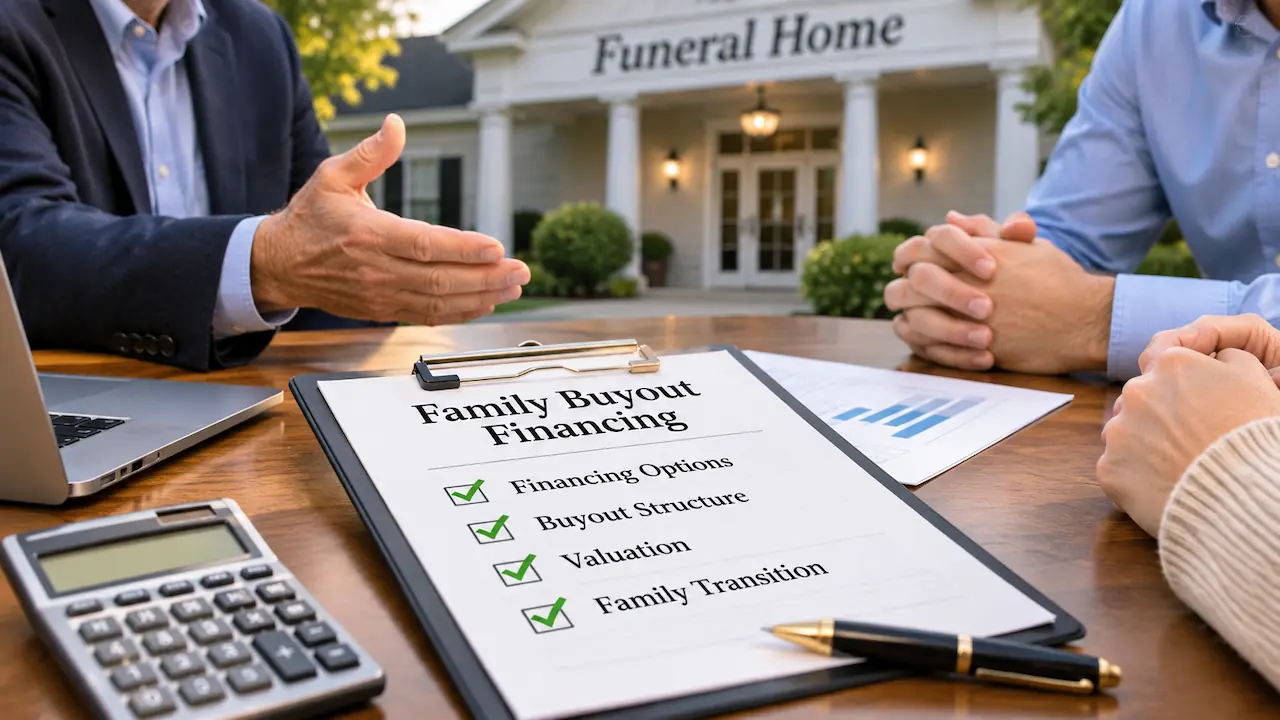
The retiring owner may need substantial proceeds for retirement, while the next generation may have limited savings or borrowing experience.
A successful family funeral home buyout requires a realistic valuation, suitable financing, and a transition plan that protects both generations.
If you’re considering transferring your funeral home to a family member, I recommend evaluating the financing structure before agreeing on a purchase price or retirement date.
What Is a Family Funeral Home Buyout?
A family funeral home buyout occurs when one family member purchases some or all of another family member’s ownership interest.
Common arrangements include children purchasing from retiring parents, siblings buying out other relatives, and successors acquiring ownership gradually.
The objective is often to preserve family ownership while compensating the departing owner fairly.
However, the successor must demonstrate the financial ability to complete the purchase and maintain operations.
My funeral home succession planning guide explains how retirement goals and ownership transitions fit into a broader succession strategy.
Step 1: Establish a Fair Funeral Home Valuation
A family transaction needs a defensible purchase price, even when relatives agree on the transfer.
An informal valuation may create problems with financing approval, retirement planning, or disagreements between family members.
A professional valuation typically considers:
- Historical earnings and normalized cash flow
- Annual funeral call volume
- Revenue per case and service mix
- Real estate and business assets
- Outstanding liabilities
- Local market conditions
Real estate may require separate analysis from the operating business.
An independent valuation also helps distinguish the business’s market value from any intentional family discount or gift.
My funeral home valuation resources explain the financial factors influencing business value.
Step 2: Explore Financing Options for the Family Buyout
Several financing arrangements may be available depending on the successor’s qualifications and business performance.
SBA 7(a) Acquisition Financing
An eligible SBA 7(a) loan may finance the acquisition of an existing funeral home, including qualifying family ownership transfers.
For eligible complete changes of ownership, the standard minimum equity injection is generally 10% of total project costs.
Partial ownership changes may have different requirements. Approval also depends on borrower qualifications, repayment capacity, and applicable SBA rules.
Conventional Bank Financing
Conventional commercial loans may suit financially strong businesses and well-qualified successors.
Banks examine historical earnings, collateral, borrower experience, and repayment ability. Equity requirements and loan terms vary by lender.
Seller Financing
Seller financing allows the retiring owner to receive part of the purchase price through scheduled payments.
This can reduce the amount requiring immediate bank financing, but the seller assumes repayment risk.
The agreement should clearly define interest, payment schedules, security, and default provisions.
Combined Financing
A family buyout may combine bank financing with a seller note.
This structure can provide immediate proceeds while allowing the remaining purchase price to be paid over time.
My bank financing versus seller financing guide compares these approaches in greater detail.
Step 3: Calculate What the Family Successor Can Afford
The proposed purchase price should reflect available financing and sustainable business cash flow.
Consider this hypothetical family funeral home buyout:
| Financial Measure | Illustrative Amount |
| Agreed purchase price | $1,200,000 |
| Buyer equity contribution | $120,000 |
| Bank acquisition loan | $880,000 |
| Seller-financed note | $200,000 |
| Total purchase funding | $1,200,000 |
The buyer contributes $120,000, obtains $880,000 in bank financing, and finances the remaining $200,000 through the seller.
The retiring owner would receive $1 million at closing before transaction expenses and adjustments, with the remaining $200,000 payable under the seller note.
This example is illustrative, not a guaranteed SBA-compliant financing structure. Actual loan eligibility, seller-note treatment, acquisition expenses, and working capital requirements must be reviewed separately.
The successor must also demonstrate that the funeral home’s cash flow can support the resulting debt payments.
Step 4: Understand SBA Rules for Family Ownership Transfers
Family ownership transfers do not automatically qualify for special financing treatment.
Under SBA SOP 50 10 8.1, effective October 1, 2026, eligible complete acquisitions generally require a minimum 10% equity injection.
Seller debt may count toward that requirement only when applicable standby and funding-source conditions are satisfied.
Under the standard framework, seller debt generally must remain on full standby for the life of the SBA loan to qualify toward the equity injection, with limits on qualifying sources.
A separate policy effective November 11, 2026, provides eligible veteran buyers additional flexibility to satisfy their required equity using permitted outside funding sources.
This does not eliminate the equity requirement or guarantee loan approval.
Because family transfers can involve different ownership structures, buyers should confirm the applicable requirements with their lender before negotiating seller-financing terms.
Step 5: Protect the Retiring Owner’s Financial Position
The buyout should provide appropriate financial protection for the retiring owner without creating excessive obligations for the successor.
Important considerations include:
- Cash required at closing
- Retirement income expectations
- Seller-note repayment terms
- Security and default protections
- Tax consequences
- Ongoing management responsibilities
A seller who accepts installment payments should understand the financial risks if business performance declines.
Attorneys, accountants, and financial advisers can help structure appropriate agreements.
Even among trusted relatives, written terms help prevent misunderstandings.
Step 6: Prepare the Successor for Ownership
Financing alone does not guarantee a successful family transition.
The successor must also be prepared to manage employees, maintain community relationships, oversee financial operations, and satisfy applicable licensing requirements.
Clear management responsibilities should be established before closing.
If the retiring owner remains involved temporarily, both parties should agree on responsibilities, decision-making authority, and the expected transition period.
A documented plan supports operational stability while ownership changes.
Common Mistakes in Family Funeral Home Buyouts
Family transactions can become complicated when important financial questions remain unresolved.
Common mistakes include agreeing on a price without an independent valuation, assuming seller financing replaces required equity, overlooking working capital, and relying on earnings that cannot support acquisition debt.
Families should also avoid delaying conversations about retirement expectations or future management responsibilities.
Addressing these issues early can reduce financing delays and disagreements.
Frequently Asked Questions
Can an SBA loan finance a funeral home purchase from a family member?
Yes. Eligible family ownership transfers may qualify for SBA 7(a) financing, depending on the transaction structure, borrower qualifications, business cash flow, and applicable program requirements.
Can parents finance the sale of their funeral home to their children?
Yes. Parents may provide financing through an installment note. However, repayment terms, tax consequences, and lender requirements should be reviewed before completing the arrangement.
How much down payment does a family funeral home buyer need?
For eligible complete acquisitions under SBA 7(a), the standard minimum equity injection is generally 10% of total project costs. Actual requirements depend on the transaction and lender.
Can a family member buy a funeral home without paying the full price upfront?
Yes. Bank financing, seller financing, or a combination may allow payments over time, provided the structure is financially sustainable and approved by the lender.
Should a funeral home be independently valued before a family buyout?
Generally, yes. An independent valuation supports fair pricing, financing discussions, and clearer expectations among family members.
Plan a Family Funeral Home Buyout With Confidence
A family funeral home buyout can preserve the business’s legacy while providing the retiring owner with a planned financial exit.
The strongest transitions combine realistic valuation, appropriate financing, and clear succession agreements.
If you’re considering transferring your funeral home to a family member, I can help you evaluate financing options and determine whether the transaction is financially workable.
Contact me for a confidential family buyout financing discussion or call (913) 343-2357 to discuss your succession plans.
Helpful next steps for this topic

Please Share this Article if you think others would find it Informative:
