
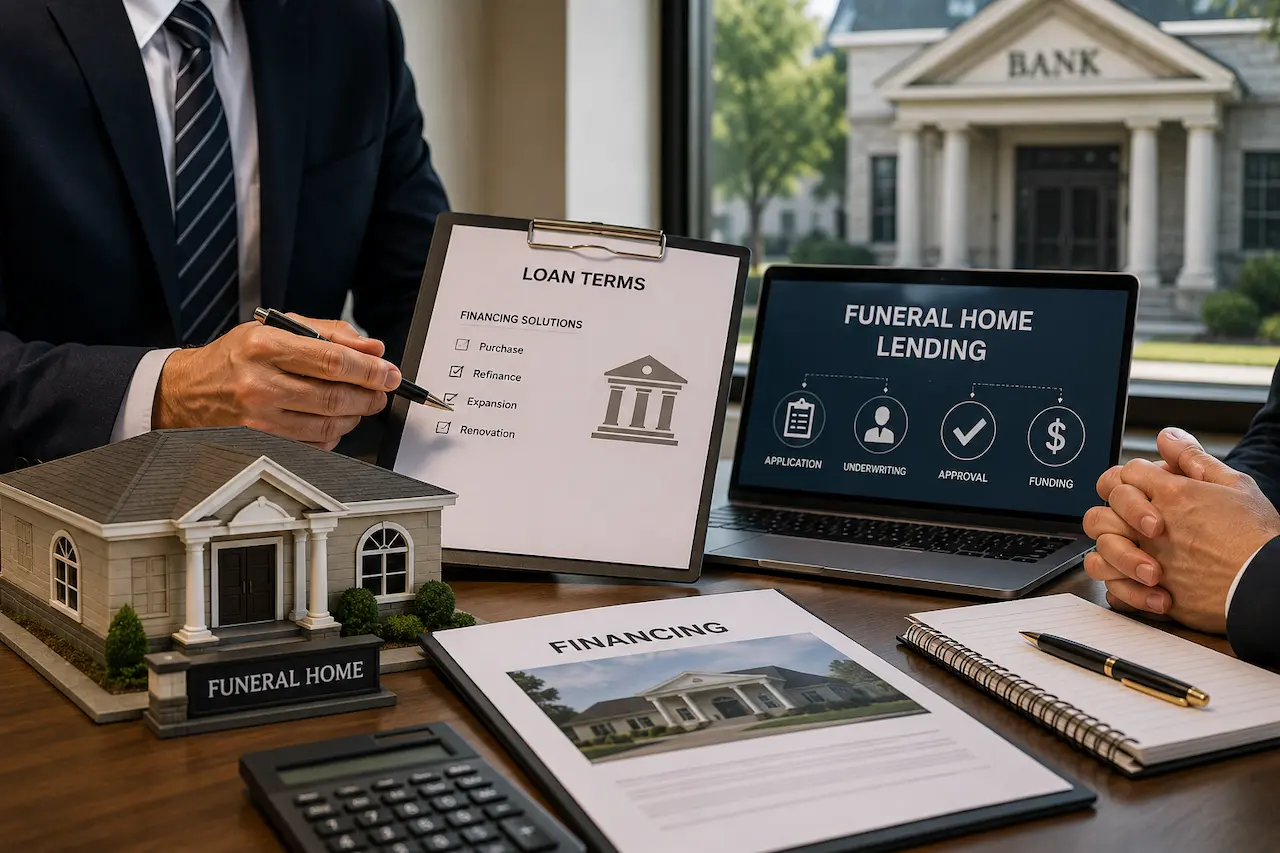
What Is Funeral Home Lending? How Bank Financing Works for Funeral Home Transactions
Funeral home lending is a specialized segment of SBA and commercial financing, where the underlying asset, a licensed death care business, requires a lender with direct experience in funeral home transactions.
Most commercial banks do not have this experience. The ones that do approach funeral home loans very differently from general small business lending.
Why Funeral Home Lending Is a Specialized Niche
A funeral home is not a typical small business, and a lender who does not understand the industry can misjudge nearly every part of the deal.
A few things make this niche different from ordinary commercial lending:
- Preneed contracts and trust obligations do not behave like normal liabilities on a balance sheet.
- Real estate often includes a licensed prep room and chapel space that require specific zoning and permits.
- Revenue is tied to call volume and community trust, not inventory turns or repeat retail sales.
- Licensing transfers add regulatory steps that most general business loans never encounter.
We have seen firsthand how a lender unfamiliar with these factors either declines a good deal outright or structures it in a way that hurts both buyer and seller. A lender who treats preneed liabilities like ordinary debt, for example, can undervalue a stable business simply because they misread what those obligations actually mean for future cash flow.
How SBA Loans Work for Funeral Home Transactions
SBA 7(a) loans are the backbone of financing for funeral home transactions in most cases, because they allow smaller down payments and longer repayment terms than a conventional bank loan.
That said, an SBA loan for a funeral home still requires a lender comfortable underwriting the industry. The lender needs to evaluate seller’s discretionary earnings, real estate value, preneed liabilities, and the buyer’s relevant experience, all at the same time. A generalist lender will often slow this process down simply because they are learning the industry as they go. Our financing guidance covers what a qualified lender actually looks for before approving a funeral home loan.
I always advise clients to confirm a lender’s funeral home experience before submitting a full application, not after.
Bank Financing vs Seller Financing for Funeral Home Loans
Not every funeral home loan comes entirely from a bank. Many transactions combine bank financing with a seller financing component, especially when real estate makes up a significant share of the purchase price.
Seller financing can bridge the gap between what a bank will lend and what the deal actually requires. It also signals to the primary lender that the seller has confidence in the business continuing to perform after closing, which can make an otherwise borderline application look far more attractive.
There are a few things worth understanding about this structure before you agree to it:
- Seller financing usually involves a longer payout period than a bank offers on its own.
- Most banks require a subordination agreement before approving the primary loan.
- A seller carrying part of the note can strengthen a buyer’s overall application.
- The seller takes on real risk if the business underperforms after the sale.
For a detailed comparison of these two approaches, see our guide on bank financing versus seller financing.
What Lenders Look for in a Funeral Home Loan Application
A strong funeral home loan application goes well beyond a credit score and a down payment.
Lenders want to see three years of clean financial statements, a realistic valuation based on seller’s discretionary earnings rather than revenue, and clear documentation of preneed contracts and their funding status. Buyer experience matters too. A buyer with a background in funeral service, or a solid management plan for post closing operations, presents far less risk than someone entering the industry with no relevant history.
Lenders will also want to understand how the business generates its revenue. A funeral home with a healthy mix of at need and preneed business, steady case volume, and diversified referral sources typically underwrites more smoothly than one dependent on a single funeral director or referral relationship. We prioritize a strategy that gets these details organized before a buyer approaches a lender, since a well prepared package moves through underwriting noticeably faster than one assembled on the fly.
Refinancing an Existing Funeral Home Loan
A funeral home loan is not only relevant to buyers. Current owners sometimes refinance an existing loan to free up cash, lower a rate, or restructure debt tied to real estate that has appreciated significantly.
This is especially common once an existing SBA loan balance drops relative to the value of the underlying real estate, creating an opportunity to refinance on better terms. Our guide on refinancing a funeral home loan explains when this move makes sense and what the process typically involves.
What Buyers Should Know Before Applying
Buyers pursuing a funeral home loan should treat the application process as a partnership with the lender, not a formality to get through.
Relevant industry experience, a reasonable down payment, and a clean credit history all strengthen an application. So does a clear plan for staffing and day to day operations after closing, since lenders want confidence the business will keep performing under new ownership. Our buying guidance walks through the full qualification picture for anyone actively pursuing a funeral home purchase.
What Happens Next
If you are exploring financing options, whether as a buyer, a seller evaluating a buyer’s financing, or an owner considering a refinance, the conversation is worth having early. You can reach out to us directly to talk through your specific situation.
Funeral home loans reward preparation on both sides of the table. Buyers who understand what lenders expect, and sellers who screen for financing risk before negotiations begin, both end up closer to their goals with far less friction along the way.
Why Choose Us
We work exclusively with funeral home buyers, sellers, and owners, which means our lending guidance is grounded in real transactions rather than general small business advice.
- Twenty plus years focused only on funeral home sales, acquisitions, and financing
- Direct access to Matt Manske throughout your transaction, not a rotating team
- Deep familiarity with SBA lending as it applies specifically to funeral homes
- Financing risk screened early, before time is lost on unqualified buyers
- No high broker commissions eating into your net proceeds
Conclusion
Funeral home lending is not the same as general small business financing. Preneed liabilities, licensed real estate, and industry specific revenue patterns all require a lender who understands the business. Buyers, sellers, and owners who work with an experienced lender from the start consistently see smoother approvals and fewer surprises at closing, which ultimately protects the timeline and the value of the transaction itself.
Frequently Asked Questions
What is the most common type of funeral home loan?
SBA 7(a) loans are the most common financing tool, offering longer terms and smaller down payments than most conventional bank loans.
Do all banks offer funeral home lending?
No. Most commercial banks lack direct experience underwriting funeral home transactions, which is why working with a specialized lender matters.
Can I refinance my funeral home loan?
Yes. Many owners refinance once their loan balance drops relative to their real estate value, often to lower a rate or free up cash.
What documents do lenders require for a funeral home loan?
Three years of financial statements, licenses, preneed contract records, and basic staffing information are typically the minimum requirement.
How does seller financing affect a funeral home loan application?
A seller willing to carry part of the note can strengthen a buyer’s overall application in the eyes of a primary lender.
Helpful next steps for this topic






Please Share this Article if you think others would find it Informative:
